

Exploration rover navigation
Assignment
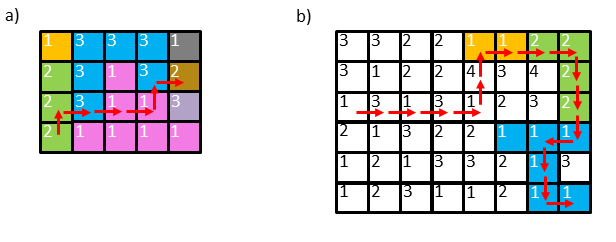
A team of NASA researches aims to navigate an exploration rover deployed on a surface of a distant planet. The environment on the surface is highly inhomogeneous in terms of pressure and temperature, which have an impact on the movement and enforce so called reconfigurations of the rover used to adapt it to varying conditions. To simplify the planning, the surface is discretized and represented by a grid map, composed of sectors. Based on the average pressure and temperature, each sector is assigned by an identifier which specifies its type. In addition, each maximal connected subset of neighboring sectors of the same type is called a region (a subset is maximal when it cannot be extended by one more neighboring sector of the same type; two sectors are neighbors if they share a side). The rover can move from each sector to a neighboring one, located northwards, westwards, southwards or eastwards. Each such movement is called a single move. It is possible to perform several single moves to relocate the rover. The rover has to be reconfigured each time it crosses a border between a region of type T1 consisting of S1 sectors and a region of type T2≠T1 consisting of S2 sectors where |S1-S2| > min(S1, S2).
The researches look for an optimal route from a starting sector to a target sector which will require to perform the minimal possible number of reconfigurations. Among all routes with the minimal number of reconfigurations, the researches search for the shortest route. The length of a route is defined as the number of single moves to be performed to follow it.
Task
You are given a map of sectors, starting position and target position. Your task is to compute the number of reconfigurations and length of an optimal route.
Input
The first input line contains two integers M and N which determine the grid size: M is the number of rows, N is the number of columns. The second input line contains integers Sr and Sc specifying the starting sector (it is located in row Sr and column Sc). Analogously, the third line contains integers Tr and Tc specifying the target sector (located in row Tr and column Tc). We consider the rows and columns to be numbered from 1 to M and N, respectively. Next, there are M input lines, each of them containing N integers, separated by a space, that describe types of sectors in the row. Each of the integers is in the range from 1 to 20.
It holds M*N ≤ 1.5*106.
Examples
Example 1
4 5
4 1
2 5
1 3 3 3 1
2 3 1 3 2
2 3 1 1 3
2 1 1 1 11 6Data and a solution of Example 1 are visualized in Image 1a).
Public data
The public data set is intended for easier debugging and approximate program correctness checking. The public data set is stored also in the upload system and each time a student submits a solution it is run on the public dataset and the program output to stdout and stderr is available to him/her.